


Stay in Touch
Get sneak previews of special offers & upcoming events delivered to your inbox.

Sign in
 Blogs & Forums
 Forums
 Blogs
Blogs

01-26-2017 04:48 PM
I think mine is both lumpy an smooth. Weird, huh? When I was in my thirties I lost all the hair on my head and one eyebrow. Docs never did figure it out. They just kept saying "Here, try this and if it doesn't work then try this other one". That''s how I know what my head looks like. Glad my hair grew back on its own.
  I became quite an eyebrow artist during that time of hair loss.LOL!
01-26-2017 04:50 PM
Some culture, might be the Chinese .I'm not sure, tell fortunes from feeling your bumps on your skull. I think its called Frenology or something like that
My head is smooth
01-26-2017 04:52 PM
I got part of it right
snip
OriginsPhrenology is the science which studies the relationships between a person's character and the morphology of the skull. It is a very ancient object of study. The first philosopher to locate mental faculties in the head was in fact Aristoteles. Several typologies have been defined, linking physionomy with character. The study of the face, physiognomony, has been particularly studied by the 18th century Swiss author Lavater. Gall and the birth of modern Phrenology 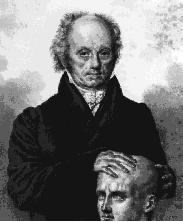 The real scientific Phrenology, which established a direct link between the morphology of the skull and the human character, was discovered by the Austrian physician Franz Joseph GALL (1758-1828). Gall put the foundations for an anatomic caracteriology. He was one of the first to consider the brain as the home of all mental activities. The real scientific Phrenology, which established a direct link between the morphology of the skull and the human character, was discovered by the Austrian physician Franz Joseph GALL (1758-1828). Gall put the foundations for an anatomic caracteriology. He was one of the first to consider the brain as the home of all mental activities. In the introduction to his main work The Anatomy and Physiology of the Nervous System in General, and of the Brain in Particular, Gall makes the following statement in regard to the principles on which he based his doctrine:
Through careful observation and extensive experimental measurements, Gall was able to link aspects of character, called faculties, to precise brain localisations. The most important collaborator of Gall was Johann SPURZHEIM (1776-1832), who successfully disseminated Phrenology in the UK and the USA.
The American brothers Lorenzo Niles FOWLER (1811-1896) and Orson S. FOWLER (1809-1887) were the leading Phrenologists of their time. Lorenzo spend much of his life in England where he set up the famous Phrenological publishing house of L.N Fowler & Co. Victorian Phrenology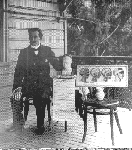 In the early 19th century, Phrenology gained a rapidly growing interest. Some scrupless people did however abuse the science for commercial purposes, and the Victorian period saw the emergence of Phrenological parlours which were closer to astrology, chiromancy, and the like, than to real scientific characterology. Unfortunately, those con-men have done a lot to stain the image of Phrenology as a real science, and their bad influence lives up to today. In the early 19th century, Phrenology gained a rapidly growing interest. Some scrupless people did however abuse the science for commercial purposes, and the Victorian period saw the emergence of Phrenological parlours which were closer to astrology, chiromancy, and the like, than to real scientific characterology. Unfortunately, those con-men have done a lot to stain the image of Phrenology as a real science, and their bad influence lives up to today. | |
| © 1998: LHOON Disclaimer: No one but the author of these pages accounts for their contents. | Go to next page: Phrenology in the 20th Century |
01-26-2017 04:54 PM
My DH has 2 lumps which are the plastic caps under his scalp that plug the drill holes from brain surgery.....now that his hairline is receeding he has found them to be quite the conversation piece...he also likes to joke and tell people stay tuned because next week there will be horns in place of the bumps. LOL
01-26-2017 04:54 PM
.... Sitting here feeling my head. 
I think it's smooth lol
01-26-2017 05:00 PM
Lumpy, like the rest of me. LOL.
01-26-2017 05:07 PM
@cherry wrote:I got part of it right
snip
The History of Phrenology
OriginsPhrenology is the science which studies the relationships between a person's character and the morphology of the skull. It is a very ancient object of study. The first philosopher to locate mental faculties in the head was in fact Aristoteles.
Several typologies have been defined, linking physionomy with character. The study of the face, physiognomony, has been particularly studied by the 18th century Swiss author Lavater. Gall and the birth of modern PhrenologyIn the introduction to his main work The Anatomy and Physiology of the Nervous System in General, and of the Brain in Particular, Gall makes the following statement in regard to the principles on which he based his doctrine:
These statements can be considered as the basic laws on which the science of Phrenology has been built.
- That moral and intellectual faculties are innate
- That their exercise or manifestation depends on organisation
- That the brain is the organ of all the propensities, sentiments and faculties
- That the brain is composed of many particular organs as there are propensities, sentiments and faculties which differ essentially from each other.
- That the form of the head or cranium represents the form of the brain, and thus reflects the relative development of the brain organs.
Through careful observation and extensive experimental measurements, Gall was able to link aspects of character, called faculties, to precise brain localisations.
The most important collaborator of Gall was Johann SPURZHEIM (1776-1832), who successfully disseminated Phrenology in the UK and the USA.
Other important authors on the subject in the last century include the Scottish brothers George COMBE (1788-1858) and Andrew COMBE (1797-1847). George Combe was the author of some of the most popular works on Phrenology and the hygiene of the mind, like The Consitution of Man or Elements of Phrenology. The picture right shows a daguerrotype of George Combe. (Thanks to Miguel Angel Cuarterolo from Argentina for this image).
The American brothers Lorenzo Niles FOWLER (1811-1896) and Orson S. FOWLER (1809-1887) were the leading Phrenologists of their time. Lorenzo spend much of his life in England where he set up the famous Phrenological publishing house of L.N Fowler & Co.
Victorian Phrenology© 1998: LHOON
Disclaimer:
No one but the author of these pages
accounts
for their contents.Go to next page: Phrenology in the 20th Century
That is so interesting. Thanks for posting, cherry.
01-26-2017 05:08 PM
funny question and some even funnier answers! 😄
mom suffered from osteoporosis and said somehow her head became lumpy. really don't know what caused the lumpiness, but it wasn't always that way. my head is pretty smooth.
01-26-2017 05:30 PM
Thanksgiving evening, after everyone left, I went full blown Britany Spears and shaved my head. I went from shoulder length hair to nada.
Surprisingly, my head is much smaller, smoother and better shaped than I thought. I prepared to look like Shrek, but found I really LOVE not having a big ol' pile of hair to deal with. My daughter and I are enjoying watching it grow back in, like a chia head...lol
01-26-2017 05:34 PM
Lumpy heads used to be a study. Probably a con, too 



Get sneak previews of special offers & upcoming events delivered to your inbox.
*You're signing up to receive QVC promotional email.

Find recent orders, do a return or exchange, create a Wish List & more.





Privacy StatementGeneral Terms of Use
QVC is not responsible for the availability, content, security, policies, or practices of the above referenced third-party linked sites nor liable for statements, claims, opinions, or representations contained therein. QVC's Privacy Statement does not apply to these third-party web sites.
© 1995-2025 QVC, Inc. All rights reserved. | QVC, Q and the Q logo are registered service marks of ER Marks, Inc. 888-345-5788
