

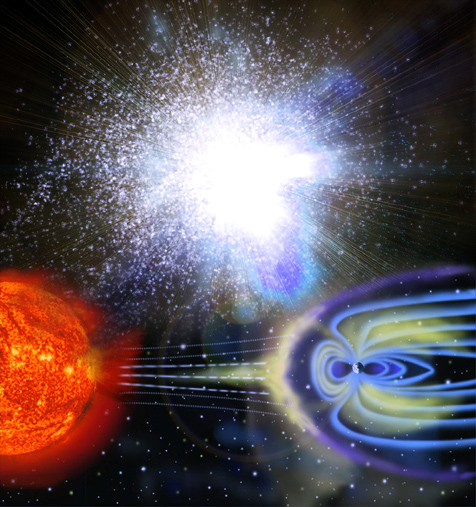
 <p class="wp-caption-text">Could the magnetic field of the Earth really reverse in 2012? I wouldnt bet on it...
 Stay in Touch
Get sneak previews of special offers & upcoming events delivered to your inbox.

Sign in
 Blogs & Forums
 Forums
 Blogs
Blogs

01-05-2011 01:26 PM
by Ian O'Neill on
<p class="wp-caption-text">Could the magnetic field of the Earth really reverse in 2012? I wouldnt bet on it... Apparently, on December 21st 2012, our planet will experience a powerful event. This time we’re not talking about Planet X, Nibiru or a “killer” solar flare, this event will originate deep within the core of our planet, forcing a catastrophic change in our protective magnetic field. Not only will we notice a rapid reduction in magnetic field strength, we’ll also see the magnetic poles rapidly reverse polarity (i.e. the north magnetic pole will be located over the South Pole and <em>vice versa). So what does this mean to us? If we are to believe the doomsayers, we’ll be exposed to the vast quantities of radiation blasting from the Sun; with a reversing magnetic field comes a weakening in the Earth‘s ability to deflect cosmic rays. Our armada of communication and military satellites will drop from orbit, adding to the chaos on the ground. There will be social unrest, warfare, famine and economic collapse. Without GPS, our airliners will also plough into the ground</em>…
Related 2012 articles:
Using the Mayan Prophecy as an excuse to create new and explosive ways in which our planet may be destroyed, 20 12 2012 doomsayers use the geomagnetic shift theory as if it is set in stone. Simply because scientists have said that it might happen within the next millennium appears to be proof enough that it will happen in four years time. Alas, although this theory has some scientific backing, there is no way that anyone can predict when geomagnetic reversal might happen to the nearest day or to the nearest million years…
Firstly, let’s differentiate between geomagnetic reversal and polar shift. Geomagnetic reversal is the change in the magnetic field of the Earth, where the magnetic north pole shifts to the South Polar Region and the south magnetic pole shifts to the North Polar Region. Once this process is complete, our compasses would point toward Antarctica, rather than northern Canada. Polar shift is considered to be a less likely event that occurs a few times in the evolutionary timescale of the Solar System. There are a couple of examples of planets that have suffered a catastrophic polar shift, including Venus (which rotates in an opposite direction to all the other planets, therefore it was flipped upside down by some huge event, such as a planetary collision) and Uranus (which rotates on its side, having been knocked off-axis by an impact, or some gravitational effect caused by Jupiter and Saturn). Many authors (including the doomsayers themselves) often cite both geomagnetic reversal and polar shift as being one of the same thing. This isn’t the case.
So, on with geomagnetic reversal…
How often does it happen?

The Earths interior (University of Chicago)
The reasons behind the reversal of the magnetic poles is poorly understood, but it is all down to the internal dynamics of Planet Earth. As our planet spins, the molten iron in the core flows freely, forcing free electrons to flow with it. This convective motion of charged particles sets up a magnetic field which bases its poles in the North and South Polar Regions (a dipole). This is known as the dynamo effect. The resulting magnetic field approximates a bar magnet, allowing the field to envelop our planet.
This magnetic field passes through the core to the crust and pushes into space as the Earth’s magnetosphere, a protective bubble constantly being buffeted by the solar wind. As the solar wind particles are usually charged, the Earth’s powerful magnetosphere deflects the particles, only allowing them into the polar cusp regions where the polar magnetic fieldlines become “open.” The regions at which these energetic particles are allowed to enter glow as aurorae.
Usually this situation can last for aeons (a stable magnetic field threaded through the North and South Polar Regions), but occasionally, the magnetic field is known to reverse and alter in strength. Why is this?
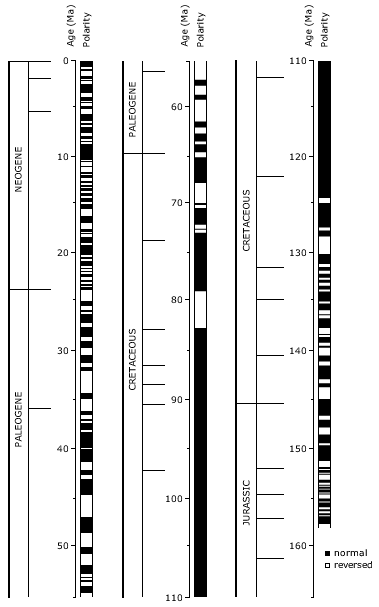
A chart showing Earths polarity reversals over the last 160 million years. Black = normal polarity, White = reversed polarity. From Lowrie (1997)
Again, we simply do not know. We do know that this magnetic pole flip-flop has occurred many times in the last few million years, the last occurred 780,000 years ago according to ferromagnetic sediment. A few scaremongering articles have said geomagnetic reversal occurs with “clockwork regularity” – this is simply not true. As can be seen from the diagram (left), magnetic reversal has occurred fairly chaotically in the last 160 million years. Long-term data suggests that the longest stable period between magnetic “flips” is nearly 40 million years (during the Cretaceous period over 65 million years BC) and the shortest is a few hundred years.
Some 2012 theories suggest that the Earth’s geomagnetic reversal is connected to the natural 11-year solar cycle. Again, there is absolutely no scientific evidence to support this claim. No data has ever been produced suggesting a Sun-Earth magnetic polarity change connection.
So, already this doomsday theory falters in that geomagnetic reversal does not occur with “clockwork regularity,” and it has no connection with solar dynamics. We are not due a magnetic flip as we cannot predict when the next one is going to occur, magnetic reversals occur at seemingly random points in history.
What causes geomagnetic reversal?
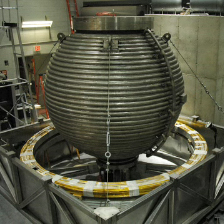
The model Earth, can a magnetic field be modelled in the lab? (Flora Lichtman, NPR)
Research is afoot to try to understand the internal dynamics of our planet. As the Earth spins, the molten iron inside churns and flows in a fairly stable manner for millennia. For some reason during geomagnetic reversal, some instability causes an interruption to the steady generation of a global magnetic field, causing it to flip-flop between the poles.
In a previous Universe Today article, we discussed the efforts of geophysicist Dan Lathrop’s attempts to create his own “model Earth,” setting a 26 tonne ball (containing a molten iron analogue, sodium) spinning to see if the internal motion of the fluid could set up a magnetic field. This huge laboratory experiment is testament to the efforts being put into understanding how our Earth even generates a magnetic field, let alone why it randomly reverses.
A minority view (which, again is used by doomsayers to link geomagnetic reversal with Planet X) is that there may be some external influence that causes the reversal. You will often see associated with the Planet X/Nibiru claims that should this mystery object encounter the inner Solar System during its highly elliptical orbit, the magnetic field disturbance could upset the internal dynamics of the Earth (and the Sun, possibly generating that “killer” solar flare I discussed back in June). This theory is a poor attempt to link several doomsday scenarios with a common harbinger of doom (i.e. Planet X). There is no reason to think the strong magnetic field of the Earth can be influenced by any external force, let alone a non-existent planet (or was that a brown dwarf?).
The magnetic field strength waxes and wanes…
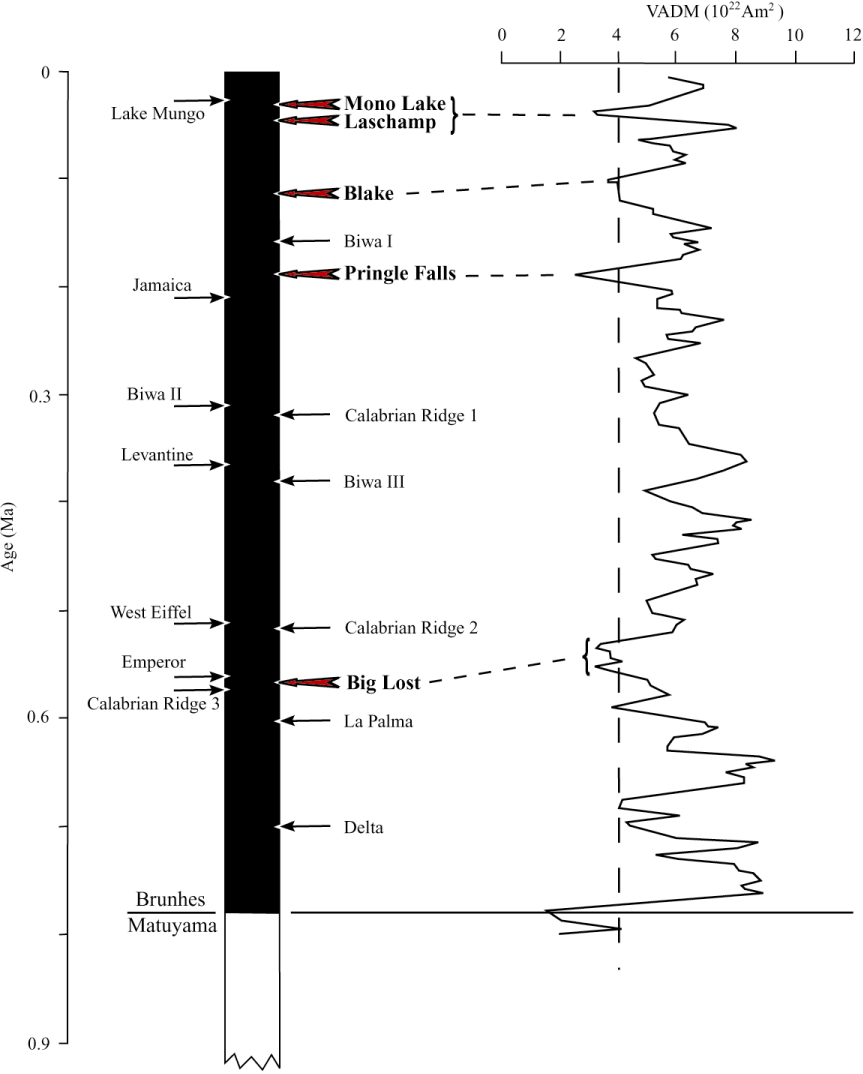
Variations in geomagnetic field in western US since last reversal. The vertical dashed line is the critical value of intensity below which Guyodo and Valet (1999) consider several directional excursions to have occurred.
New research into the Earth’s magnetic field was published recently in the September 26th issue of Science, suggesting that the Earth’s magnetic field isn’t as simple as we once believed. In addition to the North-South dipole, there is a weaker magnetic field spread around the planet, probably generated in the outer core of the Earth.
The Earth’s magnetic field is measured to vary in field strength and it is a well known fact that the magnetic field strength is currently experiencing a downward trend. The new research paper, co-authored by geochronologist Brad Singer of the University of Wisconsin, suggests that the weaker magnetic field is critical to geomagnetic reversal. Should the stronger dipole (north-south) field reduce below the magnetic field strength of this usually weaker, distributed field, a geomagnetic reversal is possible.
“The field is not always stable, the convection and the nature of the flow changes, and it can cause the dipole that’s generated to wax and wane in intensity and strength,” Singer said. “When it becomes very weak, it’s less capable of reaching to the surface of the Earth, and what you start to see emerge is this non-axial dipole, the weaker part of the field that’s left over.” Singer’s research group analysed samples of ancient lava from volcanoes in Tahiti and Germany between 500,000 and 700,000 years ago. By looking at an iron-rich mineral called magnetite in the lava, the researchers were able to deduce the direction of the magnetic field.
The spin of the electrons in the mineral is governed by the dominant magnetic field. During times of strong dipolar field, these electrons pointed toward the magnetic North Pole. During times of weak dipolar field, the electrons pointed to wherever the dominant field was, in this case the distributed magnetic field. They think that when the weakened dipolar field drops below a certain threshold, the distributed field pulls the dipolar field off-axis, causing a geomagnetic shift.
“The magnetic field is one of the most fundamental features of the Earth,” Singer said. “But it’s still one of the biggest enigmas in science. Why [the flip] happens is something people have been chasing for more than a hundred years.”
Our meandering magnetic pole
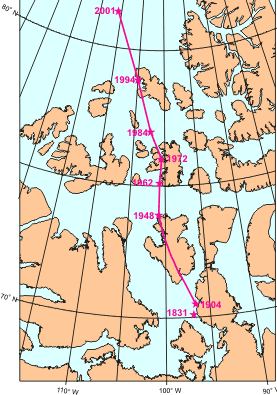
The movement of Earth's north magnetic pole across the Canadian arctic, 1831--2001 (Geological Survey of Canada)
Although there appears to be a current downward trend in magnetic field strength, the current magnetic field is still considered to be “above average” when compared with the variations measured in recent history. According to researchers at Scripps Institution of Oceanography, San Diego, if the magnetic field continued to decrease at the current trend, the dipolar field would effectively be zero in 500 years time. However, it is more likely that the field strength will simply rebound and increase in strength as it has done over the last several thousand years, continuing with its natural fluctuations.
The positions of the magnetic poles are also known to be wondering over Arctic and Antarctic locations. Take the magnetic north pole for example (pictured left); it has accelerated north over the Canadian plains from 10 km per year in the 20th Century to 40 km per year more recently. It is thought that if the point of magnetic north continues this trend, it will exit North America and enter Siberia in a few decades time. This is not a new phenomenon however. Ever since James Ross’ discovery of the location of the north magnetic pole for the first time in 1831, it’s location has meandered hundreds of miles (even though today’s measurements show some acceleration).
So, no doomsday then?
Geomagnetic reversal is an engrossing area of geophysical research that will continue to occupy physicists and geologists for many years to come. Although the dynamics behind this event are not fully understood, there is absolutely no scientific evidence supporting the claim that there could be a geomagnetic reversal around the time of December 21st, 2012.
Besides, the effects of such a reversal have been totally over-hyped. Should we experience geomagnetic reversal in our lifetimes (which we probably won’t), it is unlikely that we’ll be cooked alive by the Solar Wind, or be wiped out by cosmic rays. It is unlikely that we’ll suffer any mass extinction event (after all, early man, h/omo erectus, lived through the last geomagnetic shift, apparently with ease). We’ll most likely experience aurorae at all latitudes whilst the dipolar magnetic field settles down to its new, reversed state, and there might be a small increase in energetic particles from space (remember, just because the magnetosphere is weakened, doesn’t mean we wont have magnetic protection), but we’ll still be (largely) protected by our thick atmosphere.
Satellites may malfunction and migrating birds may become confused, but to predict world collapse is a hard pill to swallow.
In conclusion:
So, do you think there will be a geomagnetic reversal event in 2012? I thought not.
Once again, we find another 2012 doomsday scenario to be flawed in so many ways. There is no doubt that geomagnetic reversal will happen in the future for Earth, but we’re talking about time scales anything from an optimistic (and unlikely) 500 years to millions of years, certainly not in the coming four years…
by Ian O'Neill on
We could be in for a huge firework display in 2012. The Sun will be approaching the peak of its 11-year cycle, called “solar maximum“, so we can expect a lot of solar activity. Some predictions put the solar maximum of Solar Cycle 24 even more energetic than the last solar maximum in 2002-2003 (remember all those record breaking X-class flares?). Solar physicists are already getting excited about this next cycle and new prediction methods are being put to good use. But should we be worried?
Related 2012 articles:
According to one of the many Doomsday scenarios we have been presented with in the run-up to the Mayan Prophecy-fuelled “end of the world” in the year 2012, this scenario is actually based on some science. What’s more, there may be some correlation between the 11-year solar cycle and the time cycles seen in the Mayan calendar, perhaps this ancient civilization understood how the Sun‘s magnetism undergoes polarity changes every decade or so? Plus, religious texts (such as the Bible) say that we are due for a day of judgement, involving a lot of fire and brimstone. So it looks like we are going to get roasted alive by our closest star on December 21st, 2012!
Before we go jumping to conclusions, take a step back and think this through. Like most of the various ways the world is going to end in 2012, the possibility of the Sun blasting out a huge, Earth-damaging solar flare is very attractive to the doomsayers out there. But let’s have a look at what really happens during an Earth-directed solar flare event, the Earth is actually very well protected. Although some satellites may not be…
The Earth has evolved in a highly radioactive environment. The Sun constantly fires high-energy particles from its magnetically dominated surface as the solar wind. During solar maximum (when the Sun is at its most active), the Earth may be unlucky enough to be staring down the barrel of an explosion with the energy of 100 billion Hiroshima-sized atomic bombs. This explosion is known as a solar flare and the effects of which can cause problems here on Earth.
Before we look at the Earth-side effects, let’s have a look at the Sun and briefly understand why it gets so angry every 11 years or so.
The Solar Cycle
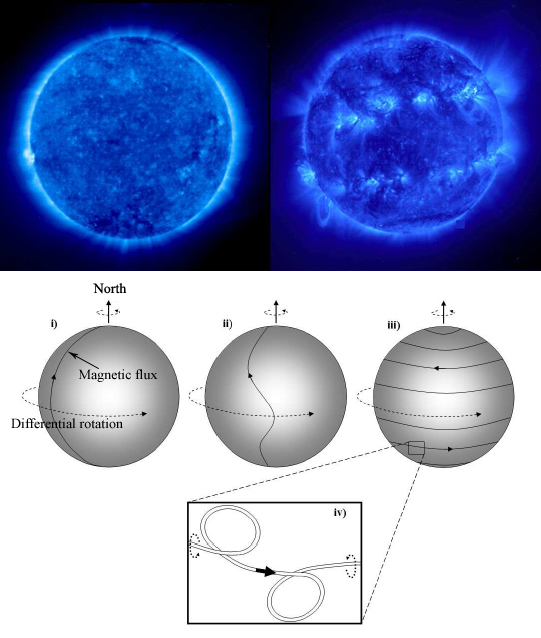
First and foremost, the Sun has a natural cycle with a period of approximately 11 years. During the lifetime of each cycle, the magnetic field lines of the Sun are dragged around the solar body by differential rotation at the solar equator. This means that the equator is spinning faster than the magnetic poles. As this continues, solar plasma drags the magnetic field lines around the Sun, causing stress and a build up of energy (an illustration of this is pictured). As magnetic energy increases, kinks in the magnetic flux form, forcing them to the surface. These kinks are known as coronal loops which become more numerous during periods of high solar activity.
This is where the sunspots come in. As coronal loops continue to pop up over the surface, sunspots appear too, often located at the loop footpoints. Coronal loops have the effect of pushing the hotter surface layers of the Sun (the photosphere and chromosphere) aside, exposing the cooler convection zone (the reasons why the solar surface and atmosphere is hotter than the solar interior is down to the coronal heating phenomenon). As magnetic energy builds up, we can expect more and more magnetic flux to be forced together. This is when a phenomenon known as magnetic reconnection occurs.
Reconnection is the trigger for solar flares of various sizes. As previously reported, solar flares from “nanoflares” to “X-class flares” are very energetic events. Granted, the largest flares my generate enough energy for 100 billion atomic explosions, but don’t let this huge figure concern you. For a start, this flare occurs in the low corona, right near the solar surface. That’s nearly 100 million miles away (1AU). The Earth is nowhere close to the blast.
As the solar magnetic field lines release a huge amount of energy, solar plasma is accelerated and confined within the magnetic environment (solar plasma is superheated particles like protons, electrons and some light elements such as helium nuclei). As the plasma particles interact, X-rays may be generated if the conditions are right and bremsstrahlung is possible. (Bremsstrahlung occurs when charged particles interact, resulting in X-ray emission.) This may create an X-ray flare.
The Problem with X-ray Solar Flares
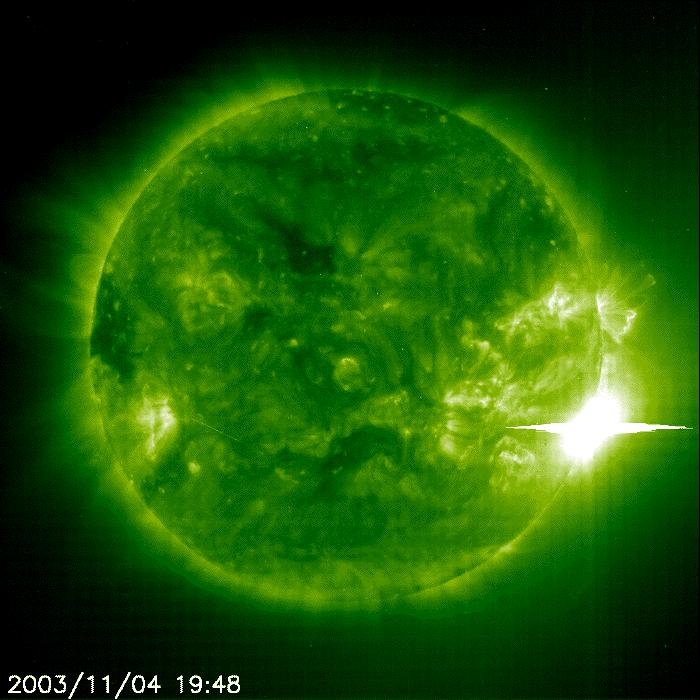
The biggest problem with an X-ray flare is that we get little warning when it is going to happen as X-rays travel at the speed of light (one of the record breaking 2003 solar flares is pictured left). X-rays from an X-class flare will reach the Earth in around eight minutes. As X-rays hit our atmosphere, they are absorbed in the outermost layer called the ionosphere. As you can guess from the name, this is a highly charged, reactive environment, full of ions (atomic nuclei, and free electrons).
During powerful solar events such as flares, rates of ionization between X-rays and atmospheric gases increase in the D and E region layers of the ionosphere. There is a sudden surge in electron production in these layers. These electrons can cause interference to the passage of radio waves through the atmosphere, absorbing short wave radio signals (in the high frequency range), possibly blocking global communications. These events are known as “Sudden Ionospheric Disturbances” (or SIDs) and they become commonplace during periods of high solar activity. Interestingly, the increase in electron density during a SID boosts the propagation of Very Low Frequency (VLF) radio, a phenomenon scientists use to measure the intensity of X-rays coming from the Sun.
Coronal Mass Ejections?
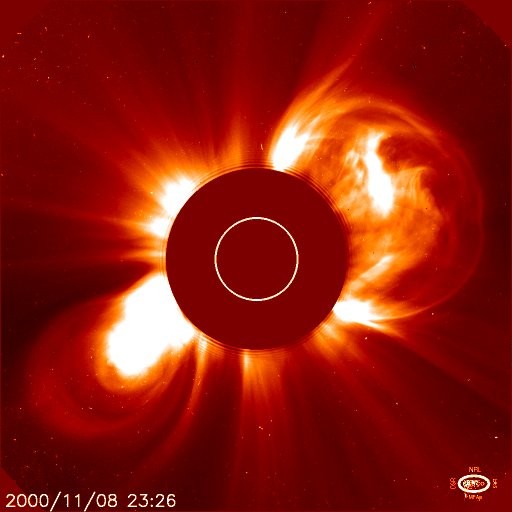
X-ray solar flare emissions are only part of the story. If the conditions are right, a coronal mass ejection (CME) might be produced at the site of the flare (although either phenomenon can occur independently). CMEs are slower than the propagation of X-rays, but their global effects here on Earth can be more problematic. They may not travel at the speed of light, but they still travel fast; they can travel at a rate of 2 million miles per hour (3.2 million km/hr), meaning they may reach us in a matter of hours.
This is where much effort is being put into space weather prediction. We have a handful of spacecraft sitting between the Earth and the Sun at the Earth-Sun Lagrangian (L1) point with sensors on board to measure the energy and intensity of the solar wind. Should a CME pass through their location, energetic particles and the interplanetary magnetic field (IMF) can be measured directly. One mission called the Advanced Composition Explorer (ACE) sits in the L1 point and provides scientists with up to an hour notice on the approach of a CME. ACE teams up with the Solar and Heliospheric Observatory (SOHO) and the Solar TErrestrial RElations Observatory (STEREO), so CMEs can be tracked from the lower corona into interplanetary space, through the L1 point toward Earth. These solar missions are actively working together to provide space agencies with advanced notice of an Earth-directed CME.
So what if a CME reaches Earth? For a start, much depends on the magnetic configuration of the IMF (from the Sun) and the geomagnetic field of the Earth (the magnetosphere). Generally speaking, if both magnetic fields are aligned with polarities pointing in the same direction, it is highly probable that the CME will be repelled by the magnetosphere. In this case, the CME will slide past the Earth, causing some pressure and distortion on the magnetosphere, but otherwise passing without a problem. However, if the magnetic field lines are in an anti-parallel configuration (i.e. magnetic polarities in opposite directions), magnetic reconnection may occur at the leading edge of the magnetosphere.
In this event, the IMF and magnetosphere will merge, connecting the Earth’s magnetic field with the Sun’s. This sets the scene for one of the most awe inspiring events in nature: the aurora.
Satellites in Peril
As the CME magnetic field connects with the Earth’s, high energy particles are injected into the magnetosphere. Due to solar wind pressure, the Sun’s magnetic field lines will fold around the Earth, sweeping behind our planet. The particles injected in the “dayside” will be funnelled into the polar regions of the Earth where they interact with our atmosphere, generating light as aurorae. During this time, the Van Allen belt will also become “super-charged”, creating a region around the Earth that could cause problems to unprotected astronauts and any unshielded satellites. For more on the damage that can be caused to astronauts and spacecraft, check out “Radiation Sickness, Cellular Damage and Increased Cancer Risk for Long-term Missions to Mars” and “New Transistor Could Side-Step Space Radiation Problem.”
As if the radiation from the Van Allen belt wasn’t enough, satellites could succumb to the threat of an expanding atmosphere. As you’d expect, as if the Sun hits the Earth with X-rays and CMEs, there will be inevitable heating and global expansion of the atmosphere, possibly encroaching into satellite orbital altitudes. If left unchecked, an aerobraking effect on satellites could cause them to slow and drop in altitude. Aerobraking has been used extensively as a space flight tool to slow spacecraft down when being inserted into orbit around another planet, but this will have an adverse effect on satellites orbiting Earth as any slowing of velocity could cause it to re-enter the atmosphere.
We Feel the Effects on the Ground Too
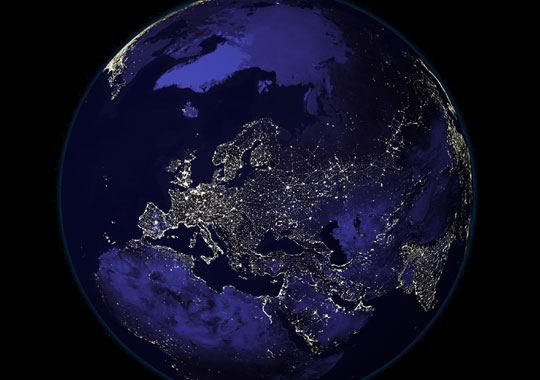
Although satellites are on the front line, if there is a powerful surge in energetic particles entering the atmosphere, we may feel the adverse effects down here on Earth too. Due to the X-ray generation of electrons in the ionosphere, some forms of communication may become patchy (or be removed all together), but this isn’t all that can happen. Particularly in high-latitude regions, a vast electric current, known as an “electrojet”, may form through the ionosphere by these incoming particles. With an electric current comes a magnetic field. Depending on the intensity of the solar storm, currents may be induced down here on the ground, possibly overloading national power grids. On March 13th 1989, six million people lost power in the Quebec region of Canada after a huge increase in solar activity caused a surge from ground-induced currents. Quebec was paralysed for nine hours whilst engineers worked on a solution to the problem.
Can Our Sun Produce a Killer Flare?

The short answer to this is “no”.
The longer answer is a little more involved. Whilst a solar flare from out Sun, aimed directly at us, could cause secondary problems such as satellite damage and injury to unprotected astronauts and blackouts, the flare itself is not powerful enough to destroy Earth, certainly not in 2012. I dare say, in the far future when the Sun begins to run out of fuel and swell into a red giant, it might be a bad era for life on Earth, but we have a few billion years to wait for that to happen. There could even be the possibility of several X-class flares being launched and by pure bad luck we may get hit by a series of CMEs and X-ray bursts, but none will be powerful to overcome our magnetosphere, ionosphere and thick atmosphere below.
“Killer” solar flares have been observed on other stars. In 2006, NASA’s Swift observatory saw the largest stellar flare ever observed 135 light-years away. Estimated to have unleashed an energy of 50 million trillion atomic bombs, the II Pegasi flare will have wiped out most life on Earth if our Sun fired X-rays from a flare of that energy at us. However, our Sun is not II Pegasi. II Pegasi is a violent red giant star with a binary partner in a very close orbit. It is believed the gravitational interaction with its binary partner and the fact II Pegasi is a red giant is the root cause behind this energetic flare event.
Doomsayers point to the Sun as a possible Earth-killer source, but the fact remains that our Sun is a very stable star. It does not have a binary partner (like II Pegasi), it has a predictable cycle (of approximately 11 years) and there is no evidence that our Sun contributed to any mass extinction event in the past via a huge Earth-directed flare. Very large solar flares have been observed (such as the 1859 Carrington white light flare)… but we are still here.
In an added twist, solar physicists are surprised by the lack of solar activity at the start of this 24th solar cycle, leading to some scientists to speculate we might be on the verge of another Maunder minimum and “Little Ice Age“. This is in stark contrast to NASA solar physicist’s 2006 prediction that this cycle will be a “doozy”.
This leads me to conclude that we still have a long way to go when predicting solar flare events. Although space weather prediction is improving, it will be a few years yet until we can read the Sun accurately enough to say with any certainty just how active a solar cycle is going to be. So, regardless of prophecy, prediction or myth, there is no physical way to say that the Earth will be hit by any flare, let alone a big one in 2012. Even if a big flare did hit us, it will not be an extinction event. Yes, satellites may be damaged, causing secondary problems such as a GPS loss (which might disrupt air traffic control for example) or national power grids may be overwhelmed by auroral electrojets, but nothing more extreme than that.
But hold on, to sidestep this issue, doomsayers now tell us that a large solar flare will hit us just as the Earth’s geomagnetic field weakens and reverses, leaving us unprotected from the ravages of a CME… The reasons why this is not going to happen in 2012 is worthy of its own article. So, look out for the next 2012 article “2012: No Geomagnetic Reversal“.
Leading image credits: MIT (supernova simulation), NASA/JPL (solar active region in EUV). Effects and editing: myself.



Get sneak previews of special offers & upcoming events delivered to your inbox.
*You're signing up to receive QVC promotional email.

Find recent orders, do a return or exchange, create a Wish List & more.






Privacy StatementGeneral Terms of Use
QVC is not responsible for the availability, content, security, policies, or practices of the above referenced third-party linked sites nor liable for statements, claims, opinions, or representations contained therein. QVC's Privacy Statement does not apply to these third-party web sites.
© 1995-2026 QVC Group, Inc. All rights reserved. | QVC, Q and the Q logo are registered service marks of ER Marks, Inc. 888-345-5788
