


Stay in Touch
Get sneak previews of special offers & upcoming events delivered to your inbox.

Sign in
 Blogs & Forums
 Forums
 Blogs
Blogs

02-09-2026 12:36 PM
When I lived in the desert West, I saw a roadrunner. I was so surprised; I never thought I'd see one in real life. The first thing that came to mind then were the Roadrunner cartoons Lol.
02-09-2026 04:21 PM
Good Afternoon, the Bird of the Day is the Greater Yellowlegs

Current conservation status is Near Threatened and the population trend is decreasing (2024).
The Greater Yellowlegs (Tringa Melanoleuca) is a large shorebird in the family Scolopacidae. It breed in central Canada and southern Alaska and winters in southern North America, Central America, West Indies and South America.
The Greater Yellowlegs is similar in appearance to the smaller Lesser Yellowlegs. Its closest relative, however, is the Greenshank. They are also the largest shanks apart from the Willet which is altogether more robustly built.
The Greater Yellowlegs and the Greenshank share a coarse, dark, and fairly crisp breast pattern as well as much black on the shoulders and back in breeding plumage. Adults have long yellow legs and a long, thin, dark bill which has a slight upward curve and is longer than the head. The body is grey-brown on top and white underneath; the neck and breast are streaked with dark brown. The rump is white. It ranges in length from 11 to 16 inches.
These birds forage in shallow water, sometimes using their bills to stir up the water. They mainly eat insects and small fish, as well as crustaceans and marine worms. It often walks in sand or mud and leaves clear tracks; it can be possible to gather information about this species using its tracks.
They nest on the ground, usually in well-hidden locations near water. The three to four eggs average 1.9 in. in length and 1.3 in. in breadth. The incubation period is 23 days. The young leave the nest within 24 hours of hatching and then leave the vicinity of the nest within two days.


02-10-2026 08:56 AM
02-10-2026 11:40 AM
Its a shame that the population is declining
02-10-2026 12:01 PM
@cowboy sam wrote:Its a shame that the population is declining
Which population?
02-10-2026 03:42 PM
saw my 1st robin today
maybe it was a scout
anyway-actually begin to warm up
snow somewhat melting
ok guys later
02-10-2026 05:21 PM
Sam's talking about the Yellowlegs I think.
02-10-2026 05:52 PM
It was sunny and 44 degrees in my part of the world today. I didn't go anywhere however 5 will get me 10 there were a bunch of guys wearing shorts. (knee length).
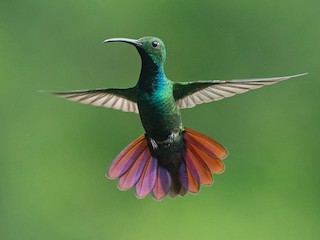
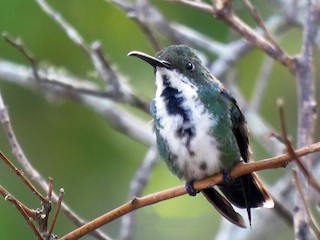
The Bird of the Day is the Green Breasted Mango
Current conservation status is Least Concern and the population trend is decreasing (2020).
The Green Breasted Mango (Anthracothorax Prevostii) is a species in subfamily Polytminae of the hummingbird family Trochilidae. It is found from eastern Mexico south through most of Central America, in Colombia and Venezuela, and as a vagrant in the United States.
The Green Breasted Mango 4.1 to 4.8 in. long and weighs 0.20 to 0.25 oz. Adult males have metallic bronze green crown, nape, and upperparts. Their innermost pair of tail feathers are dull dusky bronze green to dull coppery bronze, and the outer four pairs are shades of purple with a metallic gloss. Their wings are dusky brownish slate. They have a velvety black stripe down their chin, throat, and chest with metallic bluish green beside it. Their sides and flanks are bronze green and their undertail coverts are dusky purple.
Females have less bronzy metallic green on the crown, nape and upperparts than males. Their innermost pair of tail feathers are dull dusky bronze green to dull coppery bronze like the male's, but the outer four pairs are blue-black with a wide purple base and whitish tips. They have the same velvety black chin and throat stripe as males but it becomes bluish green on the breast, dusky on the belly, and has a white border. The rest of their underparts are metallic green but for dusky undertail coverts with wide white edges.
Juveniles are similar to adult females but have a white chin, throat, and center of the breast with some chestnut beside it.
This species breeds from eastern and southern Mexico south through Central America, including some near-shore islands, to Costa Rica. Disjunct populations occur along the northern coast of South America from extreme northeastern Colombia through northernmost Venezuela, in the upper Cauca River Valley of SW Colombia and on the coastal slope of SW Ecuador and NW Peru.
The species is partially migratory, occupying its breeding range in northeastern Mexico (southwestern Tamaulipas and eastern San Luis Potosí to southern Veracruz and extreme western Tabasco) from late February through September. Other movements are poorly understood, but the wide separation of populations in South America suggests a species-wide propensity to travel and/or a more continuous distribution during periods when South America's climate was warmer and drier. Young birds are responsible for the majority of occurrences in the United States. The species inhabits tropical deciduous forest, open landscapes with scattered large trees, orchards, gardens, and cultivated areas, but its distribution is spotty and often localized.
Like all hummingbirds, it feeds on insects and other invertebrates and nectar. Prey is often taken in mid-air but may also be gleaned from vegetation or stolen from spider webs (a behavior known as kleptoparasitism). Favorite nectar sources include the flowers of large trees such as Inga, Erythrina, and Ceiba or kapok.
The female Green Breasted Mango lays two white eggs in a tiny cup nest on a high, thin, and usually bare, branch. The exterior of the nest is camouflaged with chips of lichen and other plant fragments. Incubation by the female is 16 to 17 days, and the nestling period lasts another 24.
Female (left) and Male (right)

Male
Female
Nest

Juvenile Male
02-11-2026 09:04 AM

02-11-2026 11:27 AM
sorry,yes i was talking about the yellow legged bird in my reply to you.



Get sneak previews of special offers & upcoming events delivered to your inbox.
*You're signing up to receive QVC promotional email.

Find recent orders, do a return or exchange, create a Wish List & more.





Privacy StatementGeneral Terms of Use
QVC is not responsible for the availability, content, security, policies, or practices of the above referenced third-party linked sites nor liable for statements, claims, opinions, or representations contained therein. QVC's Privacy Statement does not apply to these third-party web sites.
© 1995-2026 QVC, Inc. All rights reserved. | QVC, Q and the Q logo are registered service marks of ER Marks, Inc. 888-345-5788
